The construction industry employs more human labor per dollar of output than almost any other major sector of the global economy. For most of its history, this was not a problem — labor was plentiful and the complexity and variability of construction work resisted automation in ways that manufacturing and logistics did not. A factory assembly line can be roboticized because the environment is controlled and the tasks are repetitive. A construction site, by contrast, is a dynamic, unstructured environment where every project is unique, every site presents different constraints, and conditions change every day.
This conventional wisdom is being challenged by a new generation of construction robots that combine advanced AI, sensor fusion, and mechanical design to operate effectively in exactly the kind of unstructured, dynamic environments that defeated their predecessors. These are not simple programmable machines following fixed scripts — they are AI-powered systems that perceive their environment, adapt to changing conditions, and execute complex tasks with the precision and consistency that human workers cannot sustainably maintain across the full workday. The era of construction robotics has arrived, and its implications for the industry are profound.
The Labor Crisis Driving Adoption
The case for construction robotics would be compelling in any labor market environment. The case in 2024 is urgent. The construction industry is in the midst of a severe and worsening labor shortage driven by the retirement of the baby boom generation of skilled tradespeople, the declining attractiveness of physically demanding trades work to younger generations, and a skills pipeline that has not kept pace with demand. In the United States, construction job openings have consistently outnumbered construction hires for over a decade, and the gap is widening.
The consequences are visible in every metric that matters to project owners and developers. Labor costs on commercial construction projects have increased at an annualized rate of 5-7% for several consecutive years, compressing margins and making projects marginal that would have been financially attractive a decade ago. Schedule delays attributable to labor shortages have become routine, not exceptional. The skilled labor bottleneck — ironworkers, electricians, pipefitters — is now the primary constraint on how quickly the construction industry can respond to infrastructure and development demand.
Into this environment, construction robots are arriving not as a threat to the industry's workforce but as an essential augmentation that allows projects to be staffed at all. The calculus for a general contractor considering a robotic bricklaying system is not "should we replace our masonry workforce?" — because there often is not enough masonry workforce available to meet demand. The calculus is "how do we complete this project on schedule when we cannot hire enough masons?"
What Today's Construction Robots Can Do
The variety and capability of commercial construction robot systems has expanded dramatically in recent years. Several categories have achieved the proof-of-concept phase and are now being deployed on real commercial projects.
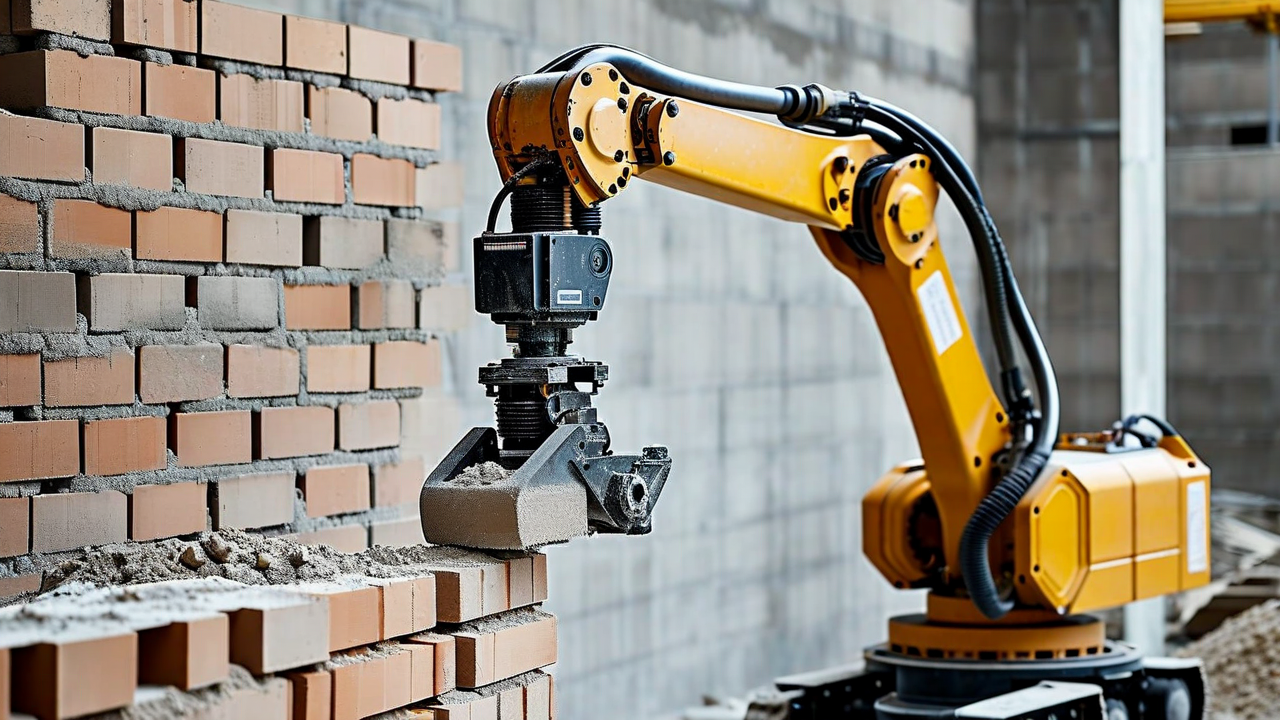
Masonry and bricklaying robots use robotic arms guided by machine vision to lay bricks and blocks with sub-millimeter precision. Advanced systems can handle irregular site conditions, work from a rolling platform that repositions autonomously, and achieve laying rates that significantly exceed human pace while maintaining consistent mortar joint quality. The human labor required is reduced to material loading, quality supervision, and tasks the robot cannot yet perform.
Rebar tying robots address one of the most physically demanding and repetitive tasks in construction — tying the thousands of intersections in a reinforcing steel mat before a concrete pour. These systems navigate the rebar grid autonomously, identify tying locations using machine vision, and tie each intersection with consistent speed and force. Early commercial deployments have demonstrated significant labor savings and reduced musculoskeletal injury rates for ironworking crews.
Autonomous earthmoving equipment has reached commercial deployment stage for specific use cases, particularly site clearing and rough grading. GPS-guided autonomous dozers and graders can execute earthwork operations with high precision, following digital terrain models without operator intervention for extended periods. Human operators are retained for setup, supervision, and the edge cases that autonomous systems cannot yet handle reliably.
Concrete placement and finishing robots are addressing one of construction's most time-sensitive and skill-intensive tasks. Robotic concrete screeds and power trowel systems can produce floor surfaces that meet tight tolerance specifications consistently, without the variability that human crews introduce when fatigued during long pours.
Inspection and surveying drones — arguably the most mature category of construction robotics — are now standard equipment on large commercial projects. Autonomous drone systems programmed with site coordinates can execute regular site surveys, generate photogrammetric point clouds for progress monitoring, and conduct infrastructure inspections at heights and in conditions that are unsafe for human inspectors.
The AI Layer: What Makes Modern Construction Robots Different
The construction robots of the current generation are qualitatively different from their predecessors in one critical dimension: they are AI-native systems that adapt to their environment rather than executing fixed programs in controlled conditions. This distinction matters enormously for practical construction deployment.
A traditional industrial robot deployed in a manufacturing plant operates in an environment that has been designed around its requirements — controlled lighting, consistent material positioning, predictable task sequence. A construction robot operates in an environment that is constantly changing, where lighting varies from direct sunlight to deep shadow, where surfaces are irregular, where unexpected obstacles appear, and where the task sequence must adapt to site conditions that differ from the plan. Only AI systems with robust perception and reasoning capabilities can operate reliably in this environment.
The AI capabilities that matter most for construction robotics are semantic scene understanding — the ability to identify and classify the objects, surfaces, and conditions in the robot's environment — and adaptive planning — the ability to modify the task execution strategy in real time based on what the robot perceives. These capabilities are advancing rapidly, driven by the same progress in deep learning and computer vision that is transforming other industries, and their improvement is the primary driver of the expanding capability envelope of commercial construction robots.
The Path to Broader Deployment
Despite impressive progress, construction robotics remains in early stages of mainstream adoption. The barriers to broader deployment are real: construction robots are expensive, requiring capital outlays that must be amortized over multiple projects to generate positive economics. Many systems require skilled technicians for setup and maintenance that are difficult to staff. And the heterogeneity of construction projects — different building types, different site conditions, different trade requirements — means that no single robot system can be broadly deployed without significant customization and adaptation.
The investment opportunities in this environment are concentrated in the companies that are most successfully addressing these barriers. Robots-as-a-service business models that shift capital costs to operating costs and bundle technical support with the hardware deployment are one promising approach. Software platforms that simplify robot programming and deployment for non-specialist construction firms are another. And the data infrastructure layer — the systems that aggregate performance data from deployed robot fleets and use it to continuously improve the AI models running them — represents a significant but less visible opportunity.
Key Takeaways
- Severe labor shortages are making construction robotics an operational necessity rather than a forward-looking experiment.
- Commercial construction robots now operate in masonry, rebar tying, earthmoving, concrete finishing, and inspection categories.
- AI-native perception and adaptive planning separate the current generation of robots from their predecessors.
- Robots-as-a-service models are lowering the capital barriers that limited earlier adoption.
- The data infrastructure layer — aggregating fleet performance data to improve AI models — is an underappreciated investment opportunity.
- Human workers are being repositioned, not replaced — construction robots are enabling projects that could not be staffed with human labor alone.
Construction robotics is a core investment focus at CoConstruct AI Ventures. We are backing founders building both hardware systems and the software and data layers that make them commercially viable at scale. Reach out to discuss your company.