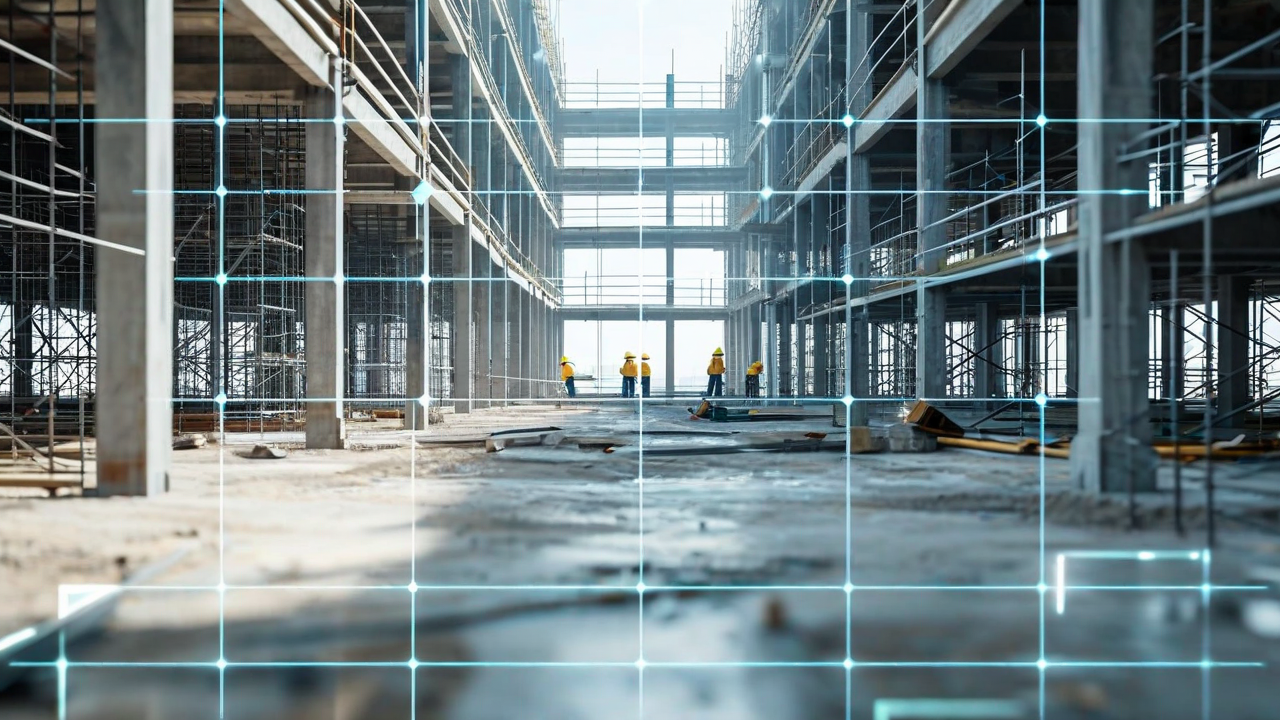
Construction sites are among the most visually complex environments on earth. At any given moment on a large commercial project, dozens of crews from different trades are working simultaneously across multiple floors, executing tasks that span from pouring concrete foundations to installing finish hardware. Equipment is moving. Materials are being staged and consumed. Conditions are changing by the hour. In this environment, the traditional model of safety and quality oversight — periodic inspections by supervisors with clipboards — captures only a fraction of what is actually happening and misses the vast majority of issues before they become incidents or defects.
Computer vision systems powered by deep learning are changing this. By deploying cameras throughout the job site and running continuous analysis on the video feeds, these systems can monitor everything that is happening on a site in real time, at a scale and consistency that no human team can match. They see what human supervisors miss. They never blink, never get tired, and never take a lunch break. And when they identify something that requires attention, they alert the right people immediately — before the safety violation becomes an injury or the quality defect becomes a costly rework.
The Safety Application: Preventing Incidents Before They Happen
Construction remains one of the most dangerous industries in the world. In the United States alone, construction accounts for approximately 20% of all workplace fatalities despite employing roughly 6% of the workforce. The so-called "Fatal Four" — falls, struck-by incidents, caught-in/between events, and electrocution — account for more than half of all construction fatalities, and the vast majority of these incidents are preventable.
Computer vision safety systems trained to detect the preconditions for these incidents are now being deployed on major projects with measurable results. Harness detection models identify workers at elevation who are not properly connected to fall protection — a violation that often goes unnoticed by supervisors managing multiple simultaneous activities. Hard hat and high-visibility vest compliance can be monitored continuously across the entire site, generating alerts when workers enter designated areas without required PPE rather than waiting for periodic walk-throughs.
More sophisticated systems go beyond compliance monitoring to behavioral analysis. A worker who is moving erratically near the edge of an elevated surface, or who appears to have stopped moving in a potentially dangerous position, can trigger an immediate alert. Vehicles operating in pedestrian zones during high-traffic periods can be flagged before a struck-by incident occurs. The goal is not surveillance but prevention — creating a safety net that catches the preconditions for incidents rather than documenting them after the fact.
The economics of this technology are compelling. A single serious injury on a construction site can cost a general contractor $500,000 to $1 million in direct costs — medical expenses, workers' compensation, OSHA fines, and legal exposure — before accounting for the indirect costs of schedule disruption, reputational damage, and workforce morale. A computer vision safety system that prevents even a handful of incidents per year pays for itself many times over.
Quality Control: Catching Defects at the Source
Construction rework is one of the industry's most significant and most avoidable cost drivers. Estimates vary, but rework typically accounts for 5-15% of total project cost — a staggering figure that represents work done, paid for, torn out, and done again. Much of this rework results from defects that could have been caught early but were not identified until later stages of construction when correction is far more expensive.
Computer vision quality control systems can identify many of these defects at the point of installation, before subsequent work conceals them. Concrete surface defects — cracks, honeycombing, delamination — can be detected in freshly poured concrete before it is covered by finishes. Rebar placement can be verified against structural drawings before the pour, catching placement errors that would otherwise require core drilling or X-ray to detect after the fact. Masonry alignment can be checked against design tolerances in real time as walls are built.
Perhaps the most powerful quality control application is progress-versus-plan comparison. By continuously comparing 3D point clouds generated from site imagery against the BIM model, vision systems can identify deviations from design intent that fall outside acceptable tolerances — not just major errors that any observer would catch, but subtle dimensional deviations that compound across multiple elements to create serious problems later. This kind of continuous conformance verification, done manually, would require an army of quality inspectors working around the clock. Computer vision makes it feasible at ordinary project budgets.
Progress Monitoring and Reporting Automation
Daily progress reporting is one of the most labor-intensive administrative tasks in construction management. Compiling daily reports from field supervisors, reconciling them with labor and material records, and translating them into schedule updates and owner reports consumes enormous amounts of management time. It is also inherently imprecise — progress estimates based on visual inspection by busy supervisors carry significant subjective error.
Computer vision progress monitoring systems replace this manual process with objective, continuous measurement. By analyzing sequences of site imagery — from fixed cameras, drone surveys, or 360-degree cameras carried by field personnel — these systems can automatically measure installed quantities for key work items: cubic yards of concrete poured, linear feet of structural steel erected, square feet of drywall installed. These measured quantities feed directly into schedule update algorithms and cost-to-complete calculations, generating progress reports that are more accurate and less labor-intensive than any manual process.
The data quality improvement has downstream benefits that extend well beyond the immediate project. When progress data is measured objectively and consistently across multiple projects, it becomes possible to build the kind of reliable historical benchmarks that have always been elusive in construction. AI models trained on this high-quality progress data develop productivity predictions that become increasingly accurate — and increasingly valuable — with each project cycle.
Equipment Utilization and Site Logistics
Construction equipment represents one of the industry's largest capital investments, and it is chronically underutilized. Studies consistently find that heavy equipment on construction sites is actively productive for only 40-60% of available working hours — the remainder is spent idle, traveling between locations, or waiting for materials or crew. At rental rates of hundreds of dollars per hour, this underutilization represents a significant and measurable cost that AI vision systems can help address.
Equipment tracking through computer vision and GPS integration allows project teams to analyze utilization patterns in detail previously impossible without dedicated observers. When an excavator is idle for extended periods, the system can surface the reason — waiting for material delivery, blocked by another piece of equipment, or simply inactive due to crew management issues — and prompt corrective action. Over time, the pattern analysis generated by these systems enables project planners to optimize equipment deployment schedules in ways that significantly improve utilization rates and reduce rental costs.
Site logistics optimization is a related application with significant ROI. Material staging areas are a perennial source of inefficiency and conflict on construction sites — materials staged in the wrong location slow work, create safety hazards, and require double-handling. Vision systems can track material flow through the site, identify congestion points, and surface recommendations for staging area optimization that reduce the travel time and handling waste embedded in traditional site logistics.
Integration and Implementation Considerations
The most effective computer vision deployments are those that integrate tightly with existing project management systems, feeding their outputs directly into the workflows where they will be acted upon. An alert that a PPE violation has been detected is only valuable if it reaches the right supervisor immediately and is tracked to resolution. A progress measurement that shows a work item behind schedule is only actionable if it is connected to the schedule update process where corrective action can be planned.
For founders building in this space, the integration layer is often where competitive advantage is created or lost. The underlying vision models for tasks like PPE detection or rebar verification are increasingly commoditized — open-source models and computer vision APIs have made the baseline capability widely accessible. What differentiates the leading platforms is the depth of integration with project management workflows, the quality of the alert routing and escalation logic, and the ability to synthesize insights across multiple data streams into a DataForge Labsnt picture of project health.
Key Takeaways
- Computer vision safety systems can detect PPE violations, unsafe behaviors, and vehicle hazards continuously across entire job sites.
- A single prevented serious injury can generate ROI exceeding the annual cost of a vision system deployment.
- Quality control vision systems catch defects at installation, before subsequent work makes correction exponentially more expensive.
- Automated progress monitoring replaces subjective field reports with objective measured quantities, improving data quality significantly.
- Equipment utilization tracking can identify and reduce the idle time that costs projects hundreds of thousands in wasted rental fees.
- Integration with project management workflows is where computer vision platforms create lasting competitive advantage.
Computer vision for construction is a high-conviction investment theme at CoConstruct AI Ventures. We are backing founders building both the core vision platforms and the workflow integrations that make them actionable. View our portfolio or contact us if you are building in this space.